3. What do you think of Glenn Ligon’s artwork entitled RUNAWAYS? What part of it is of the most interest to you and why? Also, what did you think of the related INTERWOVEN exhibit in Brownsburg, VA? What part of it is of most interest to you and why? Be sure to be very specific!
I found Glenn Ligon’s artwork entitled RUNAWAYS to be jarring yet truthful, brutal yet logical, and disheartening yet normal. The artwork depicting real images used in advertisements to catch runaway slaves juxtaposed with descriptions of Glenn Ligon given by people today illustrated to me the deep impacts of slavery in modern day racial profiling. At a first viewing, I would not think of Ligon’s artwork as anything besides historical records of runaway slave posters, but after learning about the process of creating the artwork, I had to reflect on why a black person would still be described in a manner similar to that of a runaway slave. Of course some words like “negro” or “mulatto” have left the vocabulary of the masses for their offensive and racist historical meanings, but other words like “darkskin” and “lightskin” have found its replacement as a way to further describe, divide, and categorize black people today. I am curious to see how a police officer would have described Glenn Ligon and how that would have contrasted with his work as well. I find his work already to be quite provocative, but it speaks volumes about the ways in which black people are still racially profiled today in regards to police brutality and the criminal justice system. Many have compared mass incarceration to modern slavery, and fairly so as it is the only ways in which one can legally and constitutionally make another person work without pay, and privatized prisons take advantage of that everyday while the black community is held back from equitable progress even more. I think that this artwork has found itself very relevant to the issues of black people today while highlighting a grim part of the past.
I throughly enjoyed the INTERWOVEN exhibit in Brownsburg for its truthful uncovering of a dark history in the local area that many would rather not try to confront themselves. I was truly shocked by some of the information presented in the exhibit, but it is information and knowledge that I am grateful that I now have as it has altered by perspective on the ways in which I find beauty in this area of Virginia. I pass the fields of cattle now and question how those beautiful rolling fields of grass came to be. I think of how many people suffered in the places I find comfort in Lexington and it both brings me gratitude and haunts me. My favorite part of the exhibit was the ” x-ray” like photos of the slave houses here in Rockbridge County that gave a chilling feeling from those who have lived there. I loved the combination of history with a form of unique modern art. I really enjoyed how digestible the exhibit was and how the curators stated that the museum was not meant to be politically charged. Despite the fact that I find it concerning that anyone would have a political opposition to an exhibit illustrating the historical records of local enslavement, I appreciated that they were trying to reach as many people as possible while not exploiting those who have already been exploited for centuries in the United States. Overall, I really loved getting to visit the INTERWOVEN exhibit and I would love to go back sometime.
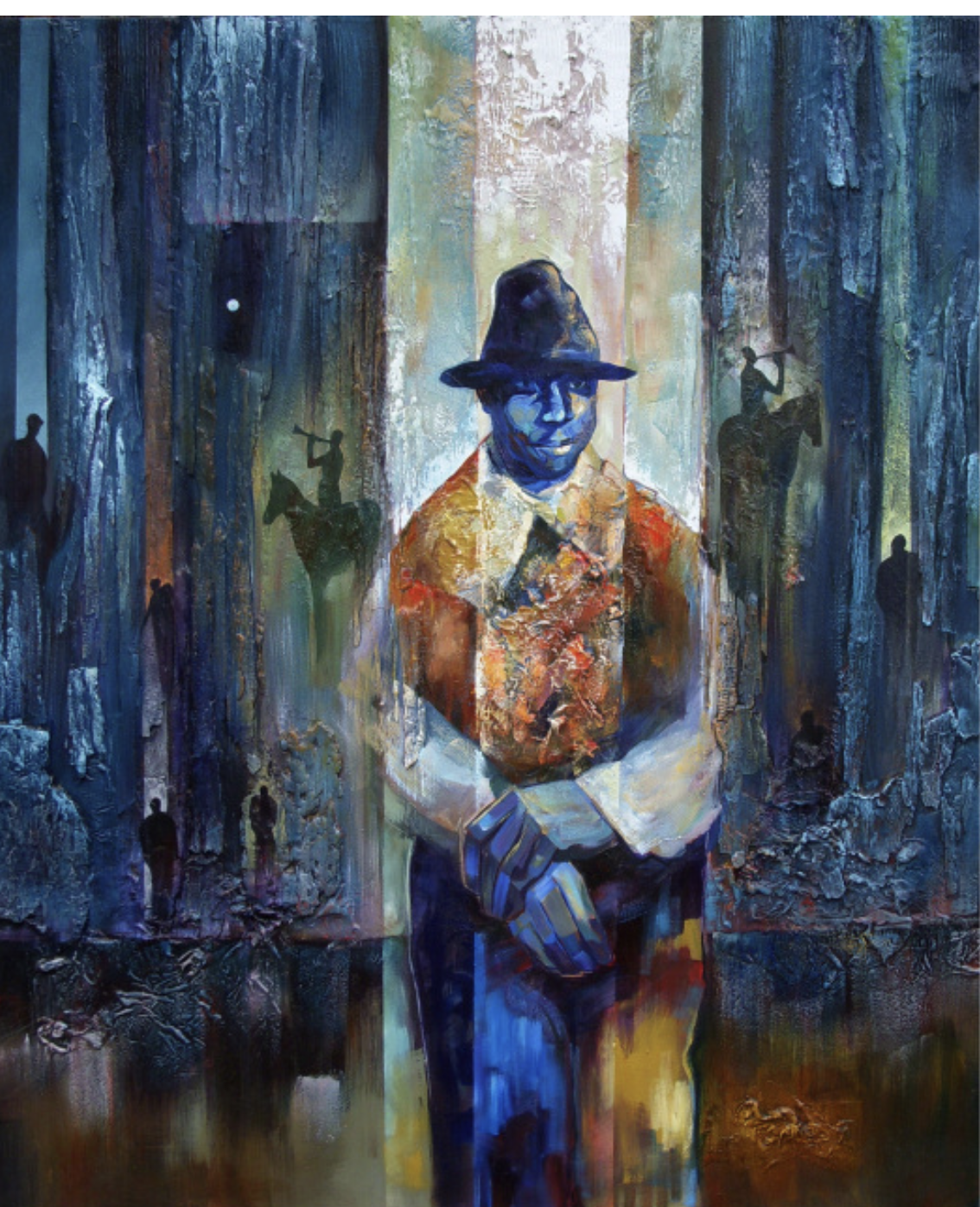
I wanted to leave a comment about the artwork that you included in this blog post. It reminds me a lot of Van Jordan’s poem “Sweet Sweet Thunder” which is about Black communities and jazz. I see in this artwork there is a Black individual and also somewhat “hidden” or shadowy figures playing instruments (ex: a trumpet, which is common in jazz.) This is just something that came to me which I found particularly interesting!