
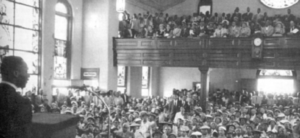
In the film Boycott, it is clear that much of life for both the black and white communities centered heavily around the church and Christianity, being used as both a way to support and discredit the merit of segregation in the film. From the first introduction of Dr. Martin Luther King Jr., the audience learns of the importance of religion in his ability to capture an audience through speech through scenes in which he preaches at the local church. His credentials in the church gave him allure and credibility within the Montgomery community, and the church was an important aspect of preserving the strength of the bus boycott. Furthermore, Dr. King utilized biblical analogies and comparisons to illustrate the inherent immorality of segregation in Montgomery, stating in one scene that if they were wrong to fight for their rights, then God is also wrong. Additionally, the church is used to organize the logistical aspects of the boycott like convincing everyone with a vehicle to carpool. Overall, the leaders of the Montgomery Bus Boycott utilized the church as a place to share information about the boycott to the community in an effective manner, while religion and Christianity is used as a methodology to defend the ethical legitimacy of the Civil Rights Movement as a whole.
In contrast, Christianity is also utilized by the White community as a way to support the legitimacy of segregation, stating that the bible defends segregation as animals of different ecosystems are not meant to integrate. This has less impact and weight than the religious claims made by MLK in regard to biblical ties to segregation but it is still utilized nonetheless by the White community to defend their practices.
To conclude, the leaders of the Montgomery Bus Boycott utilized the church as a place to share information about the boycott to the community in an effective manner, while religion and Christianity is used as a methodology to defend the ethical legitimacy of the Civil Rights Movement as a whole. The local White community in Montgomery utilized Christianity as a form of validity for continuing segregation which created an interesting juxtaposition of Christianity and race.
I find this analysis of the different uses of the Bible among Black and white folks during this time to be quite insightful. It’s interesting how certain parts of the Bible can be interpreted in a way to support multiple courses of action and ideologies. For example, one character in the film was arguing with Dr. King about having to utilize violence to incite change, citing the “eye for an eye” quote found in Leviticus. However, Dr. King utilizes a passage of the Bible that essentially states that one should not physically harm one’s oppressor and instead use love as one’s weapon. I also agree with your statement that Dr. King’s credentials as a pastor offered him an allure and credibility that a non-religious leader might not have had otherwise. Lastly, your mention of how white folks in the film utilized the Bible to characterize Black folks as “animals” astutely helps to juxtapose the differing views and morality of Blacks and whites regarding segregation.
I agree with the points brought up on the reliance of religion by the black community during the civil rights movement. Interestingly, I also saw this aspect as not only an area of strength of uniting the community but also an area of weakness and vulnerability. As mentioned, I noticed that throughout the film the leaders of the civil rights movement depended on the church and services to announce progress or news to the black community in Montgomery. While it was a functioning system, there was one scene that stood out to me. After the leaders heard about the fakes news that the boycott is over, Martin – falling back on what he knows works – said they can just tell people the news is fake at Sunday service. But surprisingly, one of the other members rebutted that not everyone goes to these services. It was then that it became apparent to the audience that the church isn’t as a reliable and dependable entity or “system” as it had been portrayed throughout the film. It highlighted a vulnerability of the church that although it serves to unite the community, it may neglect to encompass everyone in the community.
I find it very intriguing to think about how the Bible was used as evidence of reason for two opposing sides of the central issue of segregation in the 20th-century Deep South. Though, I do find it ironic that despite the Bible’s emphasizing love as the virtue that transcends all boundaries and with it being the foundation of the Christian faith, enemies of the Civil Rights Movement proudly used the Bible to promote anything but love. On the other hand, Dr. King often used the Christian notion of love to advocate for nonviolent resistance as a means to combat injustice. Similarly, Dr. King’s leadership during the Montgomery Bus Boycott and beyond was motivated by a deep sense of love for his followers, regardless of race or background. At the end of the film, Dr. King is the only individual not to board the bus which exemplifies his dissatisfaction with stopping the fight for equality after the altering of a single law. As history indicates, the Montgomery Bus Boycott was merely the beginning point for Dr. King.
I like how the film “Boycott” showcases the importance of the church and Christianity in both supporting and challenging the institution of segregation in Montgomery. I appreciate how you touched on this topic because King’s faith and his job as a preacher is a contributing factors to his nonviolent tactics. King’s preaching at local churches not only demonstrated his ability to gain support but also showed his connection between faith and civil rights. He used biblical analogies to denounce segregation and to add a moral dimension to the fight. In his famous “Letter From Birmingham Jail,” King states, “Was Paul not an extremist for the Gospel of Jesus Christ?” By using this rhetorical, biblical comparison King urges the reader to not only think about the issue at hand but to reflect on the type of person they are and their morals. This message highlights the need for interconnectedness of all communities and persistence against oppression. Moreover, the church served as a hub for organizing the aspects of the boycott, both spiritual and organizational. However, the film also highlights the troubling aspect of how Christianity was misused by the white community to justify segregation, drawing on flawed interpretations of biblical teachings. I also appreciate how you touched on the white people’s use of the Bible to push for segregation. Through that, this film offers a nuanced perspective of the intersection of religion and race. In my opinion, the film effectively shows how religion can work toward progress and can be a barrier to change depending on how it is applied and who interprets it.